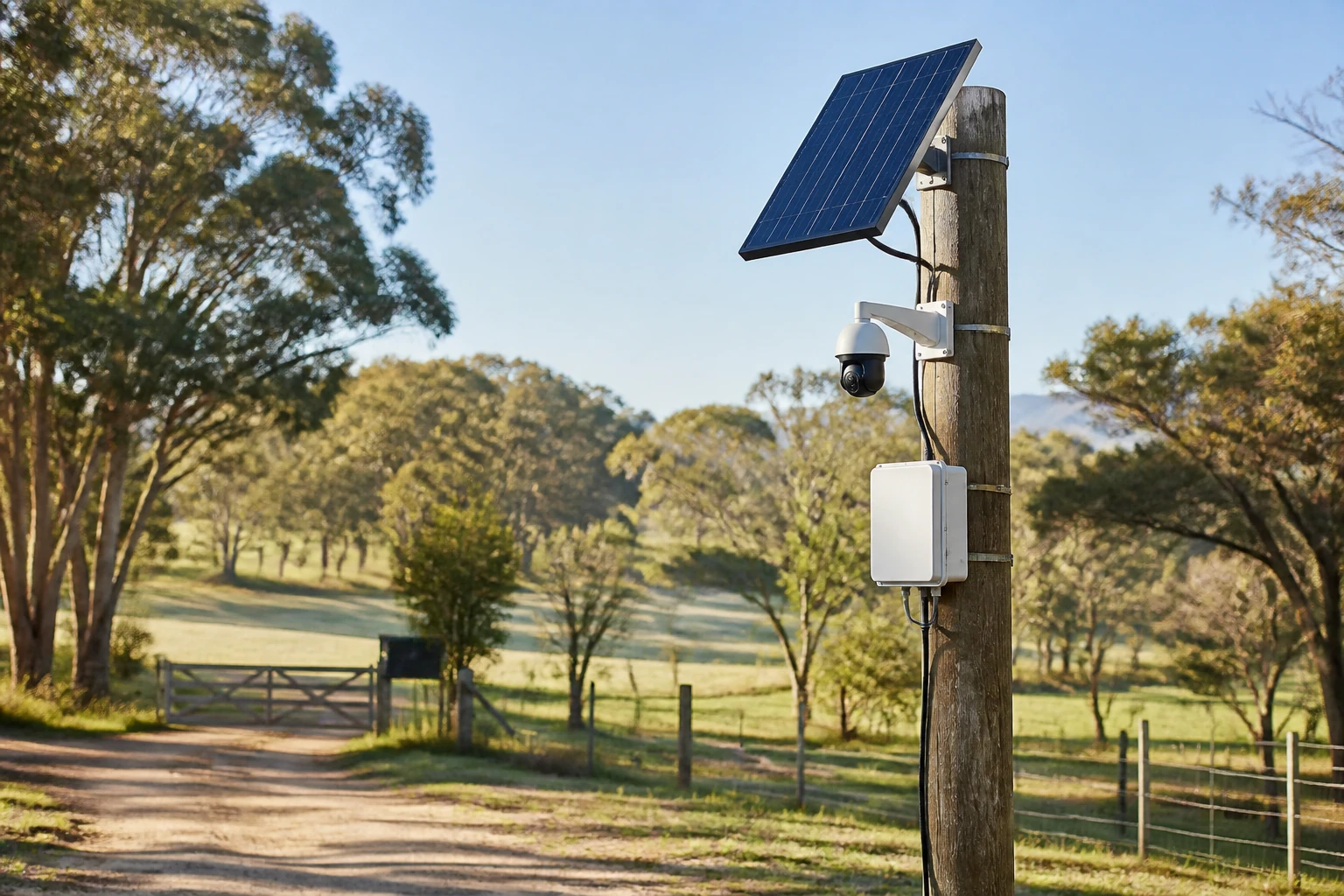
The useful answer is rarely “buy the biggest number.” This guide turns the specification sheet into an installation decision you can defend after dark, after handover and when footage is actually needed.
Design for the worst solar week
An off-grid system must survive the least productive solar period, not the average summer day. Measure the complete load of camera, modem, heater and conversion losses, then size the battery for the required autonomy. Repeated deep discharge shortens battery life and causes mysterious winter outages.
Control shade, dirt and theft risk
Panel angle, shade and dirt matter as much as rated wattage. A small shadow across part of a panel can sharply reduce output. Mount for safe cleaning and theft resistance, while preserving a cable route that does not invite water into the enclosure.
Budget cellular data and telemetry
Data plans need the same discipline. Continuous high-resolution streaming can consume far more than event clips. Prefer local recording with health telemetry and controlled retrieval, then monitor battery voltage, signal strength and last contact so failure is visible before footage is needed.
Commission the system against a written evidence goal. Save reference images and settings so future maintenance can spot gradual changes.
Can another person prove the system still works?
Record the final view, night image, bitrate, alerts, firmware and access method. A system is not finished until the owner can verify recording and export without the installer standing beside it.
Every site is different. Confirm manufacturer instructions, electrical requirements, privacy obligations and local regulations before installation.
Frequently asked questions
Can a solar security camera work without Wi-Fi?
Yes. It can record locally, and a 4G model can send alerts or remote video through a compatible cellular plan. Without Wi-Fi or cellular service, footage must be retrieved locally.
Will a solar security camera work in winter?
It can, but only when the panel, battery and load are sized for the lowest-sun period rather than summer averages.