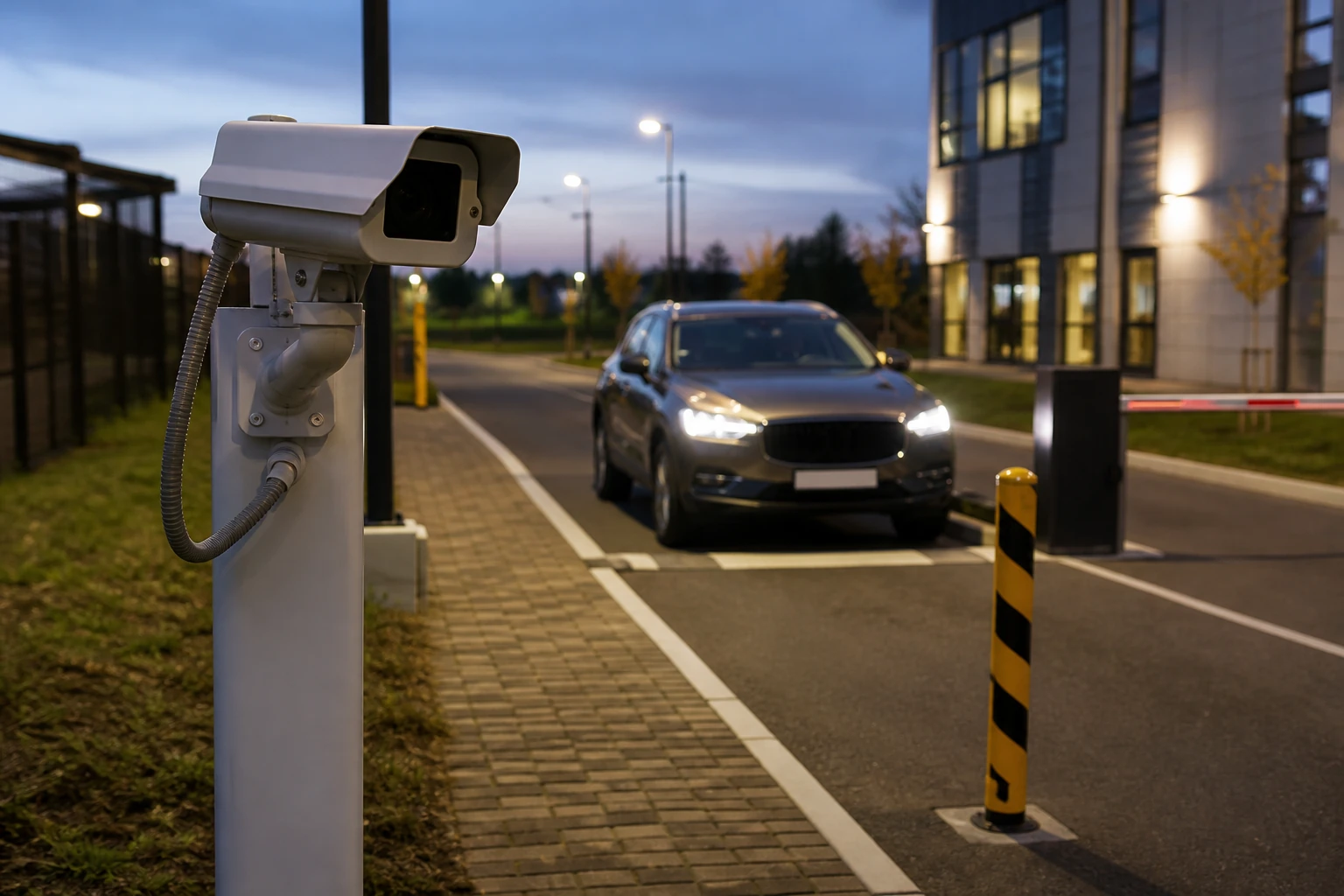
What is the practical answer?
For US residential planning, HomeAdvisor's June 2026 survey reports a typical complete project range of $593–$2,040. Treat that as broad context, then compare local itemised quotes for the same views, cable routes, retention and acceptance tests. Currency, tax and labour market matter.
What parts and labor should a quote separate?
These are broad residential planning ranges, not a price promise. Building access, cable routes, permits, regional labor, hardware grade and tax can move a real quote outside them.
| Quote line | Require a written answer | Acceptance evidence |
|---|---|---|
| Camera | Exact model, lens and target view | Recorded moving-subject clip by day and night |
| Cabling | Route, containment, access and exclusions | Labels and identified test results |
| Recorder/storage | Usable capacity and retention assumptions | Playback, disk health and an older retained export |
| Remote access | Account owner and required services | Owner login, recovery and local operation during internet loss |
| Maintenance | Warranty labour, visits and recurring costs | Named service contact and written terms |
A useful CCTV price is a scope with assumptions, not a camera count beside one large number. Separate hardware, infrastructure, labour, commissioning and ownership so competing quotes can be compared without hiding the work that determines evidence quality.
What must the installation quote actually deliver?
Begin with a written coverage schedule. For each camera, name the area, evidence task, target distance, expected lighting and whether the view must detect, recognize or identify. A driveway overview and a face view at a gate are different jobs even when both use a 4MP camera. Add retention days, recording mode, remote access, alert response and export requirements. The installer can then select lens, mounting position, illumination and recorder capacity against the same brief. Without that document, one quote may price wide context views while another assumes close identification, and the lower number wins only because it silently offers less. Camera count is useful for planning labour, but it is not a specification of what the finished system must prove.
Which camera hardware belongs in the price?
Separate camera hardware from the rest of the system. Current US cost guides put individual camera hardware across a very broad range because a basic indoor fixed camera and a supported outdoor varifocal or PTZ unit are not comparable. Exact model numbers matter: sensor, lens, low-light behaviour, weather rating, vandal resistance, audio, analytics, warranty and security-support period affect cost. Ask whether brackets, junction boxes, poles, housings and local storage cards are included. A bundle may advertise eight channels but ship four cameras, a small drive and cable unsuitable for the building. Compare the official specification and hardware revision, not a family name copied into a quotation. If an installer substitutes equipment, require approval against the same evidence task.
How should recorder and storage costs be calculated?
Recorder and storage pricing should be calculated from load and retention. List channel count, incoming bandwidth, codecs, drive bays, maximum supported drive size, RAID requirement, monitor outputs and export format. Then estimate storage from measured or planned bitrate for every camera, adding overhead and operational headroom. A cheap NVR with one bay can be entirely appropriate for a small home, but it cannot provide internal disk redundancy and may be costly to replace when expansion arrives. Include surveillance-rated drives, any required licences and a protected display or management computer. If the design uses a cloud subscription instead, show the monthly or annual cost, included retention, download limits and what the camera does when the internet or subscription stops.
Why do cable routes change the price?
Cabling and infrastructure often explain the largest difference between quotes. Price each route according to length, surface type, access, containment, penetrations, fire stopping, exterior exposure and working height. Specify traceable solid-copper cable, labelled terminations, weatherproof junctions and a test standard. Detached buildings may need fibre, local power, surge protection or a designed wireless bridge rather than an ordinary copper run. Add the PoE switch or recorder ports, cabinet, patch panel, UPS, ventilation and secure mounting for the NVR. Existing cable should be tested before its reuse becomes a saving. An allowance described only as miscellaneous materials is too vague to prove whether safe access and durable weatherproofing are actually in scope.
What does installation labour include?
Labour is not just the time spent attaching cameras. It includes survey, design, cable routing, access equipment, termination, network configuration, aiming, focus, night testing, alert tuning, documentation and training. HomeAdvisor's June 2026 US data places wired installation labour around $80 to $200 per camera and a typical complete residential project around $593 to $2,040, but local wages and building difficulty can move a real quote outside those ranges. Historic walls, occupied retail space, after-hours work, high façades, concealed routes and asbestos procedures are not equivalent to an open single-storey attic. Ask whether the figure is fixed, estimated or conditional, and which discoveries trigger a variation before work continues.
Which commissioning tests should be paid for?
Commissioning is the work most likely to disappear from a low price because it is difficult to photograph. Require a moving-person test through each target by day and night, with saved reference images. Verify time, continuous and event recording, expected retention, disk health, PoE load, alerts, local viewing and remote access. Export a clip in both native and broadly playable form and open it on another device. Disconnect the internet to prove local recording, then restore power to prove automatic recovery. Certification should list camera names, addresses, switch ports, firmware, final settings, cable labels and test results. A system that produces a live image at midday is installed; a system that passes an agreed evidence workflow is commissioned.
How do privacy and security affect the scope?
Cybersecurity and privacy can add small design costs that prevent large future liabilities. A managed switch and VLAN configuration take longer than placing every camera on the household network, but they limit access and make traffic easier to control. Unique accounts, multi-factor authentication, supported firmware, configuration backups and a maintained VPN require ownership. Privacy planning may change camera angle, add a physical shield or require masking and notices. Audio recording can carry different legal obligations from video. Ask who is responsible for updates, account recovery, staff departures and secure disposal. Do not accept direct port forwarding as a free remote-view solution merely because it avoids configuring safer access.
What will the system cost to own?
Calculate ownership across at least five years. Drives and UPS batteries are consumable; lenses, domes and enclosures need cleaning; vegetation changes scenes; accounts and firmware need review. Include optional cloud plans, cellular data, licences, monitoring, callout rates and the cost of reaching high cameras. Ask how warranty work is divided when the installer supplied the system, and what labour costs remain when a manufacturer replaces hardware only. Keep spare capacity for one or two cameras, PoE power and storage if expansion is likely. A system that starts slightly higher but uses supported, replaceable components and standard exports can cost less than a proprietary bargain that must be replaced in full after one failure.
How can you compare bids fairly?
Compare bids in a compliance table rather than by total alone. Put the coverage schedule down the left side and each installer across the top. Mark exact models, lens, recording mode, retention, route, storage, night test, export, warranty, documentation and exclusions as pass, fail or clarification required. Normalize tax and recurring costs, and separate genuine alternatives such as four high-value evidence views versus eight general overviews. Check licences, insurance and references appropriate to the jurisdiction and site. Before acceptance, agree a variation process and payment milestones tied to survey, first fix, commissioning and handover. The best CCTV installation price is not the lowest number; it is the lowest complete cost for a system whose promised evidence can be demonstrated.
How do you build a quote worksheet without double counting?
Build a quote worksheet without inventing a market price for your particular building. Put hardware, recording disks, cable and containment, installation labour, configuration, commissioning, access equipment and tax on separate lines. Mark quantities and assumptions next to each. For an illustrative four-camera plan, camera hardware might be four units multiplied by the supplier's actual unit quote, while labour may be a fixed project amount rather than four identical fees. Use the supplied quote for each term; do not multiply overlapping package totals. Add agreed recurring charges over the chosen ownership period and show optional items separately. This arithmetic exposes a cheap headline package that omits storage or commissioning, while also preventing an expensive proposal from charging twice for an included accessory.
Which local assumptions must be confirmed?
Location changes the price context. The dollar figures above describe a US residential dataset updated in June 2026, not a live quotation for another country or a commercial premises. Ask local installers to state currency, whether tax is included, travel radius, working-hour assumptions and any required permit or inspection. A simple currency conversion does not reproduce local labour rates or building rules. Before authorising work, agree how concealed-route discoveries are documented and priced, who approves variations, and what happens if the original camera position cannot meet the agreed view. After installation, keep the signed scope alongside the night-test clips and export instructions. That creates a practical basis for resolving defects instead of arguing about whether a system that merely displays live video is finished.
Ask each bidder to show one example of a night acceptance image and one handover schedule from a comparable project, with customer details removed. The answer reveals whether commissioning and documentation are real line items or marketing language. Also ask which assumptions would change the price after the survey; a clear variation list is more trustworthy than an unrealistically fixed promise based on photographs alone.
Before you sign off
- Compare quotes against one written coverage schedule
- List exact camera, lens and recorder models
- Calculate bandwidth, storage and retention
- Include cable routes, access equipment and weatherproofing
- Separate labour, configuration, commissioning and tax
- Require night, playback, outage and export tests
- Specify documentation, warranty and update ownership
- Price five-year maintenance and optional subscriptions
Can another person prove the system still works?
Record the final view, night image, bitrate, alerts, firmware and access method. A system is not finished until the owner can verify recording and export without the installer standing beside it.
Every site is different. Confirm manufacturer instructions, electrical requirements, privacy obligations and local regulations before installation.
Sources used for this guide
Primary standards and manufacturer documentation are linked so you can verify thresholds, features and current product behaviour.
Frequently asked questions
How much does CCTV camera installation cost in 2026?
HomeAdvisor's June 2026 US residential data reports a typical complete-project range of $593–$2,040. Use it only as broad context; actual local quotations depend on equipment, routes, access, testing and tax.
Is installation labour included in camera kit prices?
Not necessarily. Check the written scope for routing, mounting, termination, configuration, night testing, training and documentation, as well as hardware.
Why do quotes for the same number of cameras differ?
Different lenses, evidence goals, cable routes, recording capacity, access work, support and commissioning can make similarly sized systems materially different.
Should I convert a US estimate into my local currency?
A currency conversion does not account for local wages, taxes, equipment availability or building rules. Request itemised local quotes against the same coverage schedule.
What should I check before the final payment?
Use the agreed acceptance process to verify recorded day and night views, playback, export, account ownership, recovery, documentation and all quoted deliverables.